
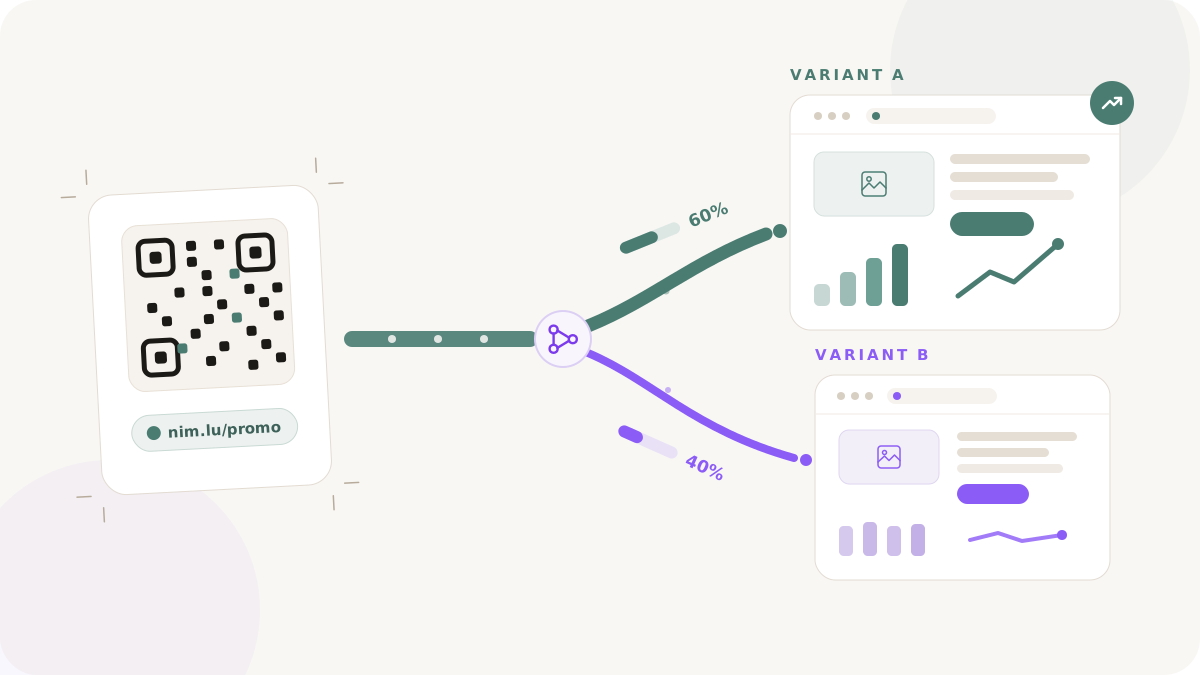
You printed 10,000 flyers with one QR code, the boxes shipped to stores last week, and now you want to know whether a shorter landing page would convert better than the one you built. The usual answer to "let's A/B test it" assumes you can change the link. You cannot. The QR is printed. Reprinting means a new code, a new production run, and a month of lead time, all to answer a question you could be answering right now.
The fix is to stop putting the test on the page and put it on the link instead. The flyer keeps pointing at the same short URL forever. Behind that URL, you split traffic between two destinations, watch which one converts, and lock in the winner without anyone touching the printed code. This is a playbook for running that kind of test on a link that has already gone out into the world.
Test at the link layer, not the page layer
A page-level A/B test changes the URL: visitors land on /pricing-a or /pricing-b, and your analytics, your email links, and your printed codes all have to agree on which is which. The moment a link is already distributed, that approach is dead.
A link-level test keeps one public URL and splits behind it. In Nimriz, a routing-enabled branded short link can hold an experiment: two or more destination variants, each with a share of traffic, sitting behind the single short URL on the flyer. Visitors never see the split. Your report still shows one link. And when you have an answer, you promote the winner into a permanent route on that same link, so nothing downstream has to change.
Set the weights, then read the right number
Start an experiment with two variants and a weight on each. A 50/50 split is the honest default for a head-to-head test; weight it unevenly only when you have a reason, like limiting exposure to a risky variant.
Then resist the urge to read clicks. Clicks tell you the split is roughly even, not that either page is better. The number that decides the test is the conversion rate per variant, so turn on conversion tracking and compare variants on the outcome you actually care about: trial starts, purchases, signups. Each conversion is attributed to the variant that earned it, so the comparison stays clean even after you rename a variant for readability.
A flyer test from launch to winner
Make it concrete with the flyer.
The QR points at links.yourbrand.com/spring. You add an experiment with two variants, both carrying the same UTMs so your downstream analytics tells the same story Nimriz does: variant A is your current long-form pricing page, variant B is a stripped-down version. You split 50/50 and write down the decision rule before launching, something like "higher trial_started rate after two full weeks, with a real volume of fresh visitors per variant." Writing it down first is what stops you from moving the goalpost later.
You launch. Traffic from the flyers flows in and splits between the two pages. You leave it alone. After two weeks you open the variant breakdown, compare conversion rates against the rule you wrote, and find B converts meaningfully better. You promote B. Nimriz turns the winning destination into a permanent route on the same short link, future traffic flows to it, and the experiment is preserved as read-only history. The flyer never changed.
The two pitfalls that distort link tests
Two behaviors will mislead you if you do not account for them.
Stickiness. A visitor is assigned to one variant on their first visit and keeps seeing it on return visits, which is what you want for a coherent experience. The consequence is that you need a steady supply of new visitors for the test to mean anything, and that the same person on their laptop and their phone counts as two visitors who may land on different variants. The practical rule: do not peek and act daily. Let real volume accumulate against the criteria you set.
Bots. Scrapers and link-preview fetchers hit your links and inflate raw counts. Nimriz separates bot-classified traffic from real visitors in analytics, so run your comparison on real visitors only. A crawler hammering one variant is noise, not a signal.
It is also worth knowing what the link layer deliberately does not do: it will not calculate statistical significance, and it will not pick a winner for you. That is intentional. You decide when the test is done and which variant ships, which keeps the team accountable for the call and the evidence. If you want a confidence interval, run the variant comparison in your own analytics stack. For how those keys line up downstream, keep variants on consistent UTMs as covered in UTM best practices.
What you get back
You answered a real conversion question on a link that was already printed, paid for, and distributed, without a reprint, a new code, or a production cycle. You can measure the payoff directly: the lift between the winning variant and the loser, and the reprint you did not have to budget for. When the next campaign ships, the same short link is ready to host the next test.
Launch your first test with the routing rules and A/B testing docs. To layer eligibility on top of an experiment (test only US traffic, or only mobile), see smart routing by country, device, and time.