
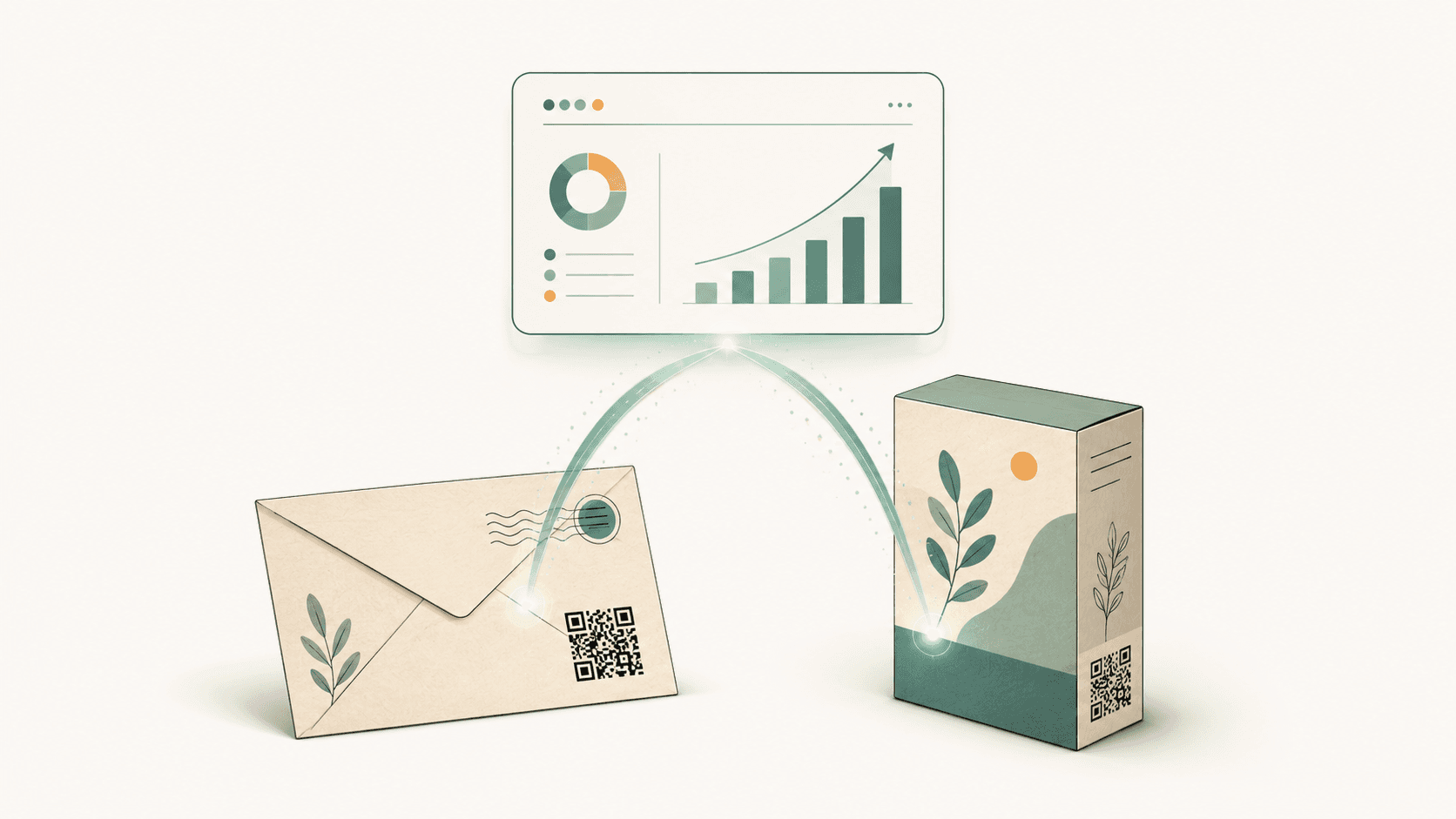
Physical and digital marketing operate in fundamentally different accountability environments. Digital ad spend is tracked, attributed, and optimized in near-real time. A social campaign that isn't working gets paused within days. A paid search keyword that is too expensive gets bid-adjusted within hours.
Physical marketing - direct mail, product packaging, event handouts, out-of-home advertising, conference materials - has traditionally operated on the other end of this spectrum. You invest a significant budget in printing and distribution, wait weeks or months for a campaign to run, and then try to infer performance from lagging brand lift surveys or indirect sales attribution. The gap between spend and insight is enormous.
Short links and QR codes close that gap. When every physical touchpoint carries a distinct, tracked short link or QR code, offline marketing earns the same analytical accountability as your best digital campaigns.
The core mechanism: one physical touchpoint, one unique link
The foundational principle is simple: every distinct physical placement where a real human might scan or type a URL should have its own unique short link. This is not about creating complexity - it is about creating precision.
When you use the same URL (yourbrand.com/promo) across every physical placement, you cannot tell:
- Whether the traffic came from the product box, the direct mail piece, or the conference flyer.
- Which city or demographic cohort is engaging with your print campaign.
- Whether Q1 packaging is driving more re-engagement than Q2 packaging.
- Whether the bottom of a direct mail letter or the back of a product insert generates more clicks.
A distinct short link per placement answers all of these questions, because every scan or URL entry arrives tagged with the identity of its source.
Product packaging: the highest-volume physical touchpoint
For consumer brands, product packaging reaches every customer who makes a purchase. That is a massive, high-intent audience that most brands treat as an afterthought for link strategy.
Consider the opportunities on packaging:
- Setup and activation: A QR code on an insert card linking to setup documentation or a video tutorial. Customers who scan this are actively engaged with the product.
- Reorder prompts: A QR code on the bottom of a consumable product package linking directly to the reorder page.
- Community and loyalty: A QR code on the inside of packaging linking to a loyalty program signup or a community forum.
- Warranty and support: A QR code linking to warranty registration or a support knowledge base.
Each of these represents a distinct intent, and each should be a distinct link. A brand that creates links.yourbrand.com/pkg-setup-q1-2026 for Q1 packaging and links.yourbrand.com/pkg-setup-q2-2026 for Q2 packaging can track cohort engagement over time. Are Q2 customers engaging with setup guidance more or less than Q1 customers? Is there a seasonal pattern? This data informs content investment, customer success strategy, and product iteration.
Direct mail: proving ROI on your highest-cost channel
Direct mail is expensive. Printing costs, list rental costs, postage, and the agency or in-house time to produce creative materials add up quickly. The traditional challenge is that attribution is weak - you mail a piece, and then you hope a portion of the audience converts.
With tracked short links, you can establish direct causal measurement:
- Assign a unique short link to each direct mail campaign (and where feasible, to each list segment or geographic target).
- Include the short link as a clean, typeable URL at the bottom of the piece, plus a QR code for convenient scanning.
- Track scans and type-ins over the campaign window.
- Cross-reference click data with conversion data for the same period.
This produces something direct mail has historically never had: a direct click-to-conversion attribution path.
For multi-variant direct mail tests (two versions of a letter, two offers, two visuals), assign a distinct short link to each variant. Performance differences become measurable.
UTM structure for direct mail:
utm_source=direct_mailutm_medium=printutm_campaign=q2_acquisitionutm_content=offer_aorutm_content=offer_b
Event and conference marketing
Events represent significant investment: booth space, travel, promotional materials, staff time. A company spending $50,000 on an industry conference should leave knowing exactly how much pipeline that investment generated.
Short links on event materials create the measurement layer:
Conference handouts. Every flyer, brochure, or one-pager gets a unique short link. links.yourbrand.com/expo-nyc-26 is the link for the New York event. links.yourbrand.com/expo-sf-26 is the link for the San Francisco event. When traffic arrives from each, you know which event generated it.
Business card QR codes. A QR code on a business card pointing to a personalized landing page or portfolio. Every scan is a measurable signal of engagement post-meeting.
Swag and branded materials. A QR code on a reusable bag, a notebook, or a badge lanyard pointing at a product trial or signup page. The long tail of event marketing - people using your swag for months after the event - becomes measurable if the QR code uses a distinct link.
Billboards and out-of-home advertising
Out-of-home advertising has the largest physical audience of any marketing format and historically the worst attribution. A billboard seen by 100,000 people daily has no mechanism for tracking engagement unless you provide one.
A QR code on a billboard is now widely expected, and many drivers and pedestrians are accustomed to scanning them. A short, typeable URL below the QR code catches the audience who sees the billboard but doesn't scan in the moment.
OOH-specific considerations:
- Keep the URL extremely short and typeable.
yourbrand.link/nycis better thanlinks.yourbrand.com/outdoor-spring-nyc-2026-billboards. - Use high-contrast QR codes at large scale. See QR code sizing for billboard-specific recommendations.
- Keep the destination URL simple and purpose-built for the campaign. Someone scanning a billboard is in a different context than someone clicking an email - the landing page should reflect that.
The 302 advantage for printed materials
The single most powerful operational decision you can make for physical marketing with QR codes: use 302 redirects (the default in Nimriz), not 301.
Here is why this matters enormously. Once you print a QR code on packaging, direct mail, or signage, you cannot change the encoded URL without reprinting. But with a 302 short link behind that QR code, you can change the destination as many times as you want.
Real-world scenario: you print 500,000 product boxes with a QR code pointing to links.yourbrand.com/box-promo. At launch, that link goes to an introductory offer. Six months later, the offer ends. With a 302 link, you update the destination in Nimriz to a post-launch loyalty page - no reprinting required. The QR code on every box still works, and every scan goes to the current, relevant destination.
This is the operational flexibility that makes short links on physical materials worth the setup effort. The QR code is printed once; the destination is managed forever.
Connecting physical data to your digital stack
The final piece of the offline-to-online picture is closing the loop: taking the click data that physical QR codes generate and connecting it to your broader marketing and customer data infrastructure.
With webhooks, click events from physical QR scans can trigger real-time downstream actions:
- A scan of a re-order QR code on a product can trigger a CRM event that marks the customer as "active re-order consideration" and enrolls them in a follow-up email sequence.
- A scan of a post-purchase setup QR code can trigger a "customer activated" milestone in your analytics platform.
- A scan of a conference QR code tied to a specific booth visitor can create a contact record in your CRM.
This level of integration requires some technical setup, but the architecture is straightforward: Nimriz fires a webhook on each click event, and your backend or automation platform (Zapier, Make, etc.) processes the event and updates the appropriate downstream system.
The result is that a physical QR scan on a product box in someone's kitchen in Minneapolis triggers a real-time event in your data infrastructure - just like a button click on your website does.
Quick-start checklist for your first physical campaign
-
Register a custom branded domain if you haven't already.
-
Design a slug structure: one slug per physical placement or cohort.
-
Attach UTM parameters for channel (
utm_medium=print) and campaign (utm_campaign=your_campaign). -
Create short links and QR codes in Nimriz.
-
Use 302 redirect type (the default) - never 301 for printed materials.
-
Test every QR code on two different phones before sending to print.
-
Set up a simple reporting view to monitor click volume by placement.
-
QR code sizing: what actually works - size and error correction guide for print
-
301 vs 302 redirects - why destination flexibility requires 302
-
UTM best practices - building your offline attribution taxonomy