
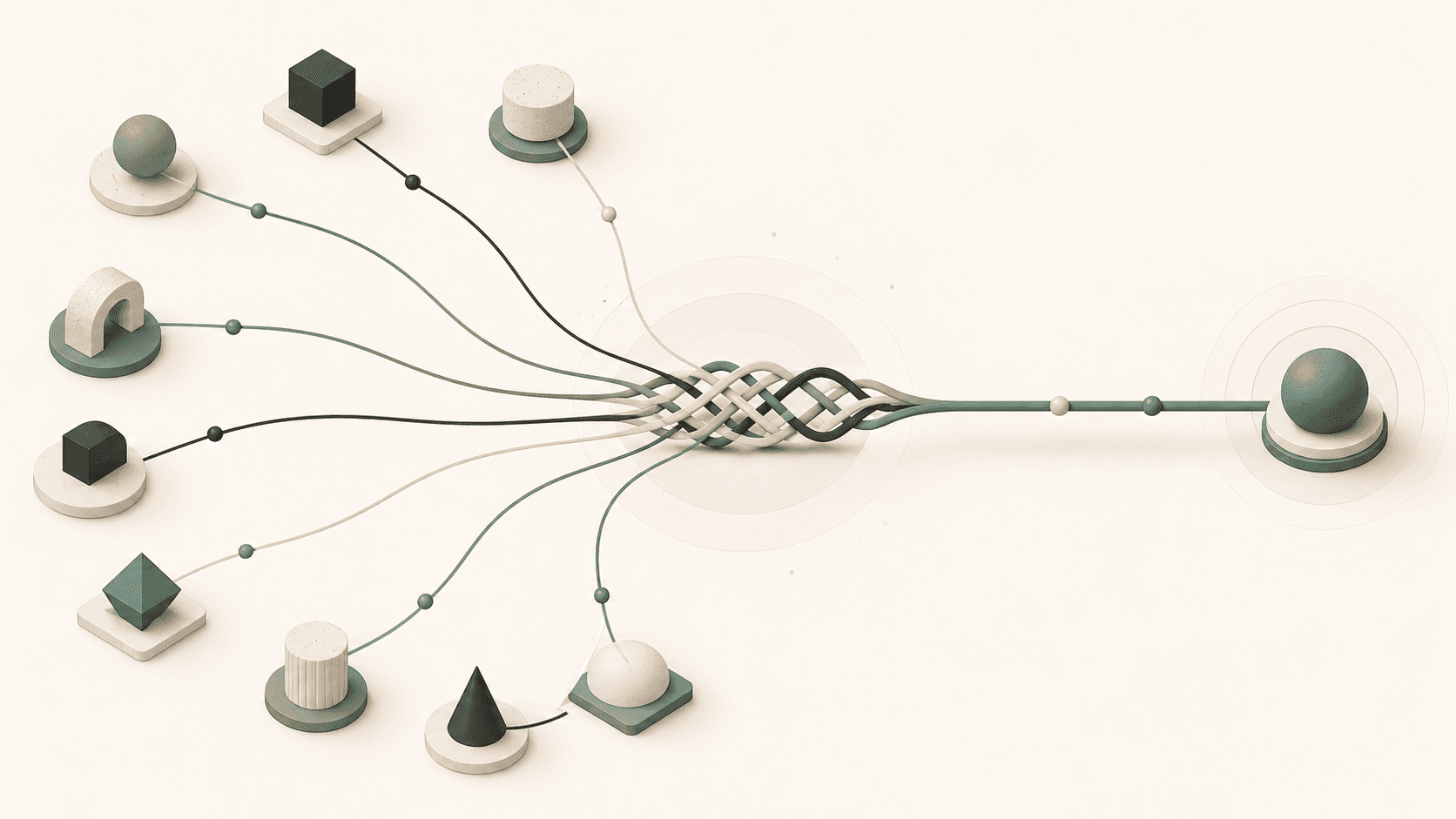
Marketing attribution is one of the most technically and conceptually challenging problems in growth. The challenge: a customer might see your Instagram ad on Monday, click a link from your newsletter on Wednesday, see a retargeting display ad on Thursday, and then click a short link in an SMS campaign on Friday before making a purchase. Which channel gets the credit?
The correct answer is: they all contributed. The practical answer for most teams is: whichever channel you've configured to get credit in your attribution model. And therein lies the problem - most attribution setups are not designed with the full customer journey in mind.
This post explains how short links fit into a multi-touch attribution framework, what data you can and cannot capture from link click events, and how to build a link strategy that gives you the clearest possible picture of your marketing's actual impact.
The attribution model landscape
Before addressing short links, it is worth briefly mapping the attribution model types that most analytics platforms offer:
Last-touch attribution. The last touchpoint before conversion gets 100% of the credit. Simple to implement, dramatically overstates the value of bottom-of-funnel channels (paid search, direct email) and dramatically understates the contribution of awareness and nurture channels.
First-touch attribution. The first trackable touchpoint gets 100% of the credit. Better for measuring what introduces customers to the brand, but ignores everything that happened between introduction and conversion.
Linear attribution. Credit is distributed equally across all touchpoints. Fairer than first or last touch, but treats every touchpoint as equally important regardless of recency, frequency, or intent signal.
Time-decay attribution. More recent touchpoints receive more credit. Recognizes that the touchpoints closest to conversion are often more intent-driven.
Data-driven attribution. Machine learning distributes credit based on observed patterns in which touchpoints correlate with conversion vs. non-conversion paths. Requires significant data volume to be reliable.
Short links contribute to any of these models, but they contribute most cleanly to models that can handle multi-touch data - because every link click is a timestamped touchpoint event.
How short link click data maps to attribution
When a user clicks a short link, Nimriz records:
- Timestamp of the click.
- The destination URL the user was sent to.
- Referrer domain (where the click originated from).
- UTM parameters appended to the destination URL.
- Device category and country.
- Bot/human classification.
This click event is one data point in the customer journey. On its own it does not reveal the full path - it is not a session recording or a cookie-tracking system. But in combination with your other data sources, it provides significant signal.
Building a coherent multi-channel link taxonomy
The foundation of multi-channel attribution through short links is a consistent UTM structure that uses the same taxonomy across every channel. When your email team, your social team, your paid team, and your SMS team all use different conventions for utm_source and utm_medium values, the data arrives in your analytics platform in fragmented buckets that cannot be joined.
A unified taxonomy looks like this:
| Channel | utm_source | utm_medium | utm_campaign |
|---|---|---|---|
| Newsletter | klaviyo | email | Campaign name |
| Paid Instagram | instagram | social_paid | Campaign name |
| Organic Instagram | instagram | social_organic | Campaign name |
| Paid Google | google_ads | cpc | Campaign name |
| SMS | attentive | sms | Campaign name |
| Direct mail | direct_mail | print | Campaign name |
The utm_campaign value is stable across all channels for the same initiative. This means in your analytics platform, filtering by utm_campaign=spring_launch_2026 returns all traffic from all channels for that campaign - email, paid, organic, SMS, print - in one unified view.
From there, breaking down by utm_medium shows the channel contribution without any join complexity.
Stitching link click data into the full journey
Short link click events are entry-point data. They tell you a user came from a specific channel with a specific UTM context. To build the full customer journey picture, you need to stitch this entry-point data with:
Session data from your analytics platform. When a user lands on your site via a UTM-tagged short link, your analytics platform (Google Analytics, Amplitude, Mixpanel) captures the session and attributes it to the UTM source. Short link click counts and analytics session counts may differ - bots, link pre-fetching by email clients, and multi-click by the same user all create discrepancies. Both data sources are useful for different questions.
Conversion data from your CRM or e-commerce platform. Purchases, signups, and qualified pipeline events are the outcomes that attribution is trying to explain. Joining UTM session data with conversion data (via user ID, order ID, or session ID) produces the attribution picture.
Webhook events from Nimriz. For use cases where you need real-time click events in your CRM or data warehouse, webhooks fire on each click event and provide the data necessary to build a cross-channel event timeline per user. This is particularly powerful for B2B sales cycles where knowing that a prospect just clicked a specific link is an actionable signal.
The direct traffic problem
One of the most persistent attribution challenges is direct traffic - sessions where no referrer or UTM data is present. Direct traffic in analytics can represent:
- Someone who typed your URL directly.
- A click from a bookmarked URL.
- A click from a source that strips UTM parameters (some email clients, some social apps in-app browsers).
- A click where the short link redirect stripped the UTM parameters from the destination (not a Nimriz behavior, but possible with other redirect configurations).
- A click from a dark social channel (WhatsApp, private Slack, private Discord) that does not pass referrer data.
Short links help with dark social attribution: if the link shared in dark social channels has UTM parameters on the destination URL, those parameters survive the redirect and register in your analytics when the user lands on your site - even though the referrer is empty.
This is why building UTMs into the destination URL (not just the short link slug) matters: it is the attribution data that survives into your analytics platform regardless of referrer behavior.
Creating controlled multi-channel experiments
Short links enable deliberate multi-channel attribution experiments. If you are running the same campaign across email and SMS and want to understand which channel drives higher conversion rates, the design is:
- Create two short links with identical destinations but distinct UTMs: one for email, one for SMS.
- Distribute each link exclusively through its designated channel.
- At the end of the campaign, compare click volume, session data, and conversion data attributed to each UTM source.
Because the destination is identical, any performance difference is attributable to the channel, not the offer or the creative. This is a clean, repeatable experiment framework for channel mix optimization.
Limitations to be honest about
Attribution through short links and UTMs is powerful but incomplete. Honest limitations:
Cross-device journeys are invisible. If a user clicks a short link from an email on their phone but converts on their laptop, the click and the conversion are in different device sessions with different cookies. Last-touch attribution may credit a different channel for the conversion.
UTM override. When a user who arrived via a UTM-tagged session from Instagram then navigates internally and then converts, different analytics platforms handle session attribution differently. Some credit the original entry UTM; some override it if the user navigates to a UTM-tagged internal page.
Bot click inflation. Without bot filtering, click counts from short link analytics may be significantly higher than the number of human visits. Use bot-classified data for clean numbers.
Model selection matters. The same click data will tell different stories depending on whether you are using first-touch, last-touch, or multi-touch attribution. There is no single "correct" model - choose one that fits your business stage and be consistent.
The practical takeaway
You do not need a sophisticated attribution platform to start building useful multi-channel insight. The minimum viable setup:
- Define and document a consistent UTM taxonomy across all channels.
- Use branded short links with UTMs on every external distribution channel.
- Connect your analytics platform to see channel-segmented traffic.
- Regularly review which channels are driving the most high-quality traffic and test reallocating budget accordingly.
The data you build with this approach, over multiple campaigns, accumulates into a meaningful picture of where your growth is actually coming from.
- UTM best practices - the foundation of multi-channel attribution
- Automating link management with APIs and webhooks - syncing click events into your CRM in real time
- Privacy-aware analytics - what click data is collected and how