
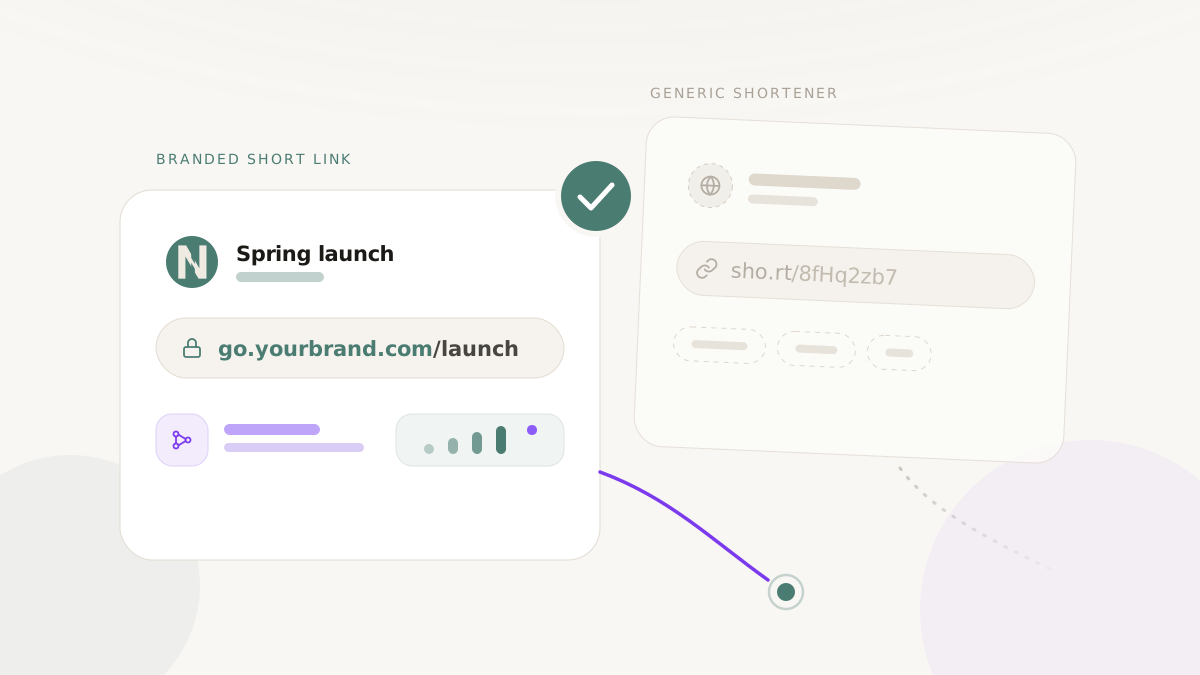
A short link can use a provider's shared domain, such as bit.ly, or a domain your organization controls, such as go.yourbrand.com. The practical difference is not a promised lift in clicks or inbox placement. It is who controls the visible hostname, naming rules, and migration options.
Use that distinction to choose the right setup for each link program.
Shared shortener and branded domain basics
A generic shortener places your slug under the provider's hostname. The provider operates the DNS, certificate, redirect service, and shared namespace. This is useful when you need a temporary link and do not need a brand-specific hostname.
A custom branded link places the slug under a domain or subdomain that your organization controls. You still depend on the link-management platform for the configured redirect, analytics, and product features, but your team controls the DNS relationship and the visible hostname.
For example:
bit.ly/spring-offeruses the provider's shared hostname.go.example.com/spring-offeruses a hostname controlled by Example.
The branded version makes the sender's domain visible. It does not prove that the destination is safe, that the message is legitimate, or that a recipient will click.
A verifiable tradeoff table
| Decision factor | Generic shortener domain | Custom branded domain |
|---|---|---|
| Visible hostname | Shows the provider's shared domain. | Shows a domain or subdomain your organization controls. |
| Slug namespace | Shares naming availability and rules with the provider's users. | Uses the namespace configured for your verified domain. |
| Initial DNS work | No domain connection is required from your team. | Requires domain ownership, DNS changes, and platform verification. |
| Brand recognition | The hostname identifies the shortener provider. | The hostname can identify your organization or campaign brand. |
| Provider migration | Existing links remain tied to the provider's domain. | Migration may be possible by changing DNS and recreating every required route with the next provider. Test this before moving traffic. |
| Analytics | Event definitions, retention, filters, and exports depend on the provider and plan. | Event definitions, retention, filters, and exports still depend on the provider and plan. A branded hostname does not change that. |
| QR use | A QR code can point to the shared short URL when the provider supports that workflow. | A QR code can point to the branded short URL when the platform supports that workflow. The printed code still needs scan testing. |
| Cost and maintenance | May avoid a separate domain and DNS workflow. Provider limits still apply. | Includes domain registration or subdomain governance, DNS access, renewal ownership, and any platform plan requirements. |
This table describes observable setup and control differences. It does not assume one option has a higher click-through rate, better deliverability, stronger uptime, or different privacy behavior.
What a branded domain does not guarantee
A custom hostname is useful infrastructure, but it is not a performance or safety certificate.
It does not guarantee:
- More clicks. Audience, offer, placement, copy, and channel context can matter more than the hostname. Measure results in your own campaign.
- Email or SMS delivery. Sender authentication, sending practices, content, recipient behavior, carrier rules, and filtering systems remain separate concerns.
- A safe destination. A familiar hostname can still redirect to a mistaken, compromised, or outdated page. Review destination ownership and access controls.
- Uninterrupted redirects. DNS, certificates, the redirect provider, account configuration, and destination hosting can each fail. Monitor the full path.
- Accurate attribution. Link events, bot filtering, UTM values, consent, conversion capture, and downstream joins still need validation.
- Privacy compliance. Review the platform's data collection, retention, subprocessors, contract terms, and your own disclosure obligations. A custom domain does not change those duties by itself.
Treat claims about click-through rate or deliverability as hypotheses to test, not benefits granted by the hostname.
When a generic shortener fits
A shared shortener can be reasonable for:
- a temporary internal link
- a one-off message where the audience already knows the sender
- a prototype that will not be printed or published as a durable route
- a team without permission to manage DNS
Before using one, confirm the provider's retention, export, redirect, account-recovery, and deletion behavior. Do not assume all generic shorteners handle UTM parameters or analytics in the same way. Test the exact URL you plan to distribute.
When a custom branded domain fits
A branded domain is a stronger operational fit when:
- the hostname should visibly identify the organization
- links will appear across campaigns, social profiles, customer messages, or printed assets
- a team needs a governed slug namespace
- domain ownership and DNS changes have a named operator
- the organization wants the option to migrate by recreating routes under a domain it controls
That migration option requires preparation. Keep an export of active slugs and destinations, document fallback behavior, and confirm the next service can reproduce required routes before changing DNS.
A practical decision check
For a durable campaign link, record these answers before publishing:
- Who owns the domain registration and DNS access?
- Who can create, edit, and retire slugs?
- Which redirect status and fallback destination are required?
- Which events does the platform record, and how are bots handled?
- How will the team export the route catalog and analytics it needs?
- How will the final short URL and any QR code be tested?
- What is the recovery plan if the account, DNS record, or destination changes?
If the link is a durable public asset, start with how to set up branded links. For the data boundary, review privacy-aware analytics. For printed campaigns, use the QR scan readiness checklist before distribution. For a current platform evaluation, review the Nimriz and Dub comparison.